


Biodiversity Net Gain and What it Means to New Homes
Biodiversity Net Gain (BNG), has been introduced today through the world-leading Environment Act, to help deliver the government's commitment to halt species decline by 2030. It means developers in England are now legally required to deliver at least a 10% increase in biodiversity through mandatory BNG for major development under biodiversity net gain legislation within the planning system.
For many years we have been planning and designing our proposals to set environmental and social improvements as an integral element of our design ethos. We saw this as the right thing to do as we understood more from our ecology teams over the last decade. We integrate biodiversity net gain through the design process and across the development process, ideally from an early stage with early engagement from ecologists. We very much leave a site whether it be a refurbishment project or a new housing/flatted development in a more environmentally conscious state than how we received it.
As part of our environmental improvements we make careful consideration of existing landscape features and how habitat improvements can be made as an integral part of the scheme.
Such improvements are good for our ecosystems and helps towards development being climate restorative from its base level.
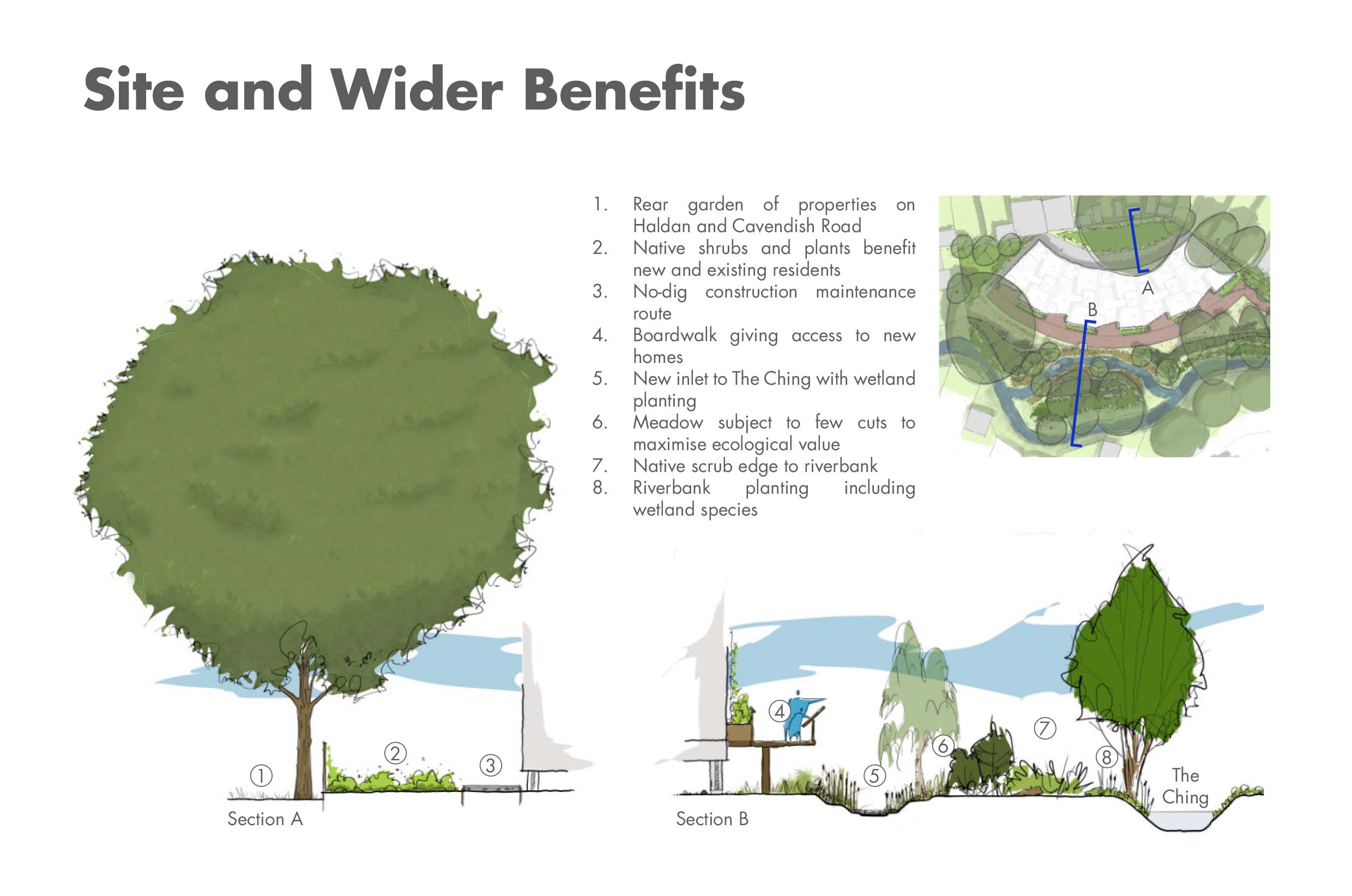
- Today (12 Feb 2024) we see Biodiversity Net Gain (BNG) become an integral national requirement in planning for Major Planning Applications, with local planning authorities applying this in line with the National Planning Policy Framework. No longer is there just reliance on an overworked Council/County Ecologist to gain such improvements. These improvements now must come forward as part of the proposal which will have a positive effect upon the natural and built environment if done correctly.
- Key Headlines:
- 12 February 2024 BNG is now a national validation requirement for Major planning applications. As a broad brush, these consist of 10 or more residential units or 1000M2 of floorspace, or site size is 0.5 hectares or more for residential development or 1 hectare for other.
- 2 April 2024 BNG will be a national validation requirement for small sites. Due to smaller sites being smaller in principle, there are exceptions to certain types of development. These include some householder applications, some self-build home applications and at present Permitted Development schemes.
- After these dates a minimum of 10% increase in BNG is required.
- All secured BNG will need a management plan to show how it is to be maintained for a minimum of 30 years.
BNG are new elements of legislation and with all new legislation a time for bedding in is required to establish the oddities of BNG for LPA and Agents (Architects and Planning Consultants) to fully understand. Secondary legislation formalises how applications must ensure compliance. New legislation always has grey areas and as such it is vital to gain specialist help from Architects and Planning Consultants to gain the best advice possible.
Depending upon the size of your proposal, if your planning application is submitted to the Local Planning Authority (LPA) after these dates, BNG NOW MUST BE integrated within the application.
The Important Baseline: Assessing Existing Biodiversity
To integrate BNG into the planning application, baseline surveys and habitat condition assessments are required to understand the existing biodiversity and biodiversity value of the site. No longer can anyone rip out all landscape features of a site and say it is just bare earth BECAUSE the baseline calculation can be back dated using aerial photos (which there are many) to ascertain its baseline prior to landscape removal onsite, with that baseline measured using the biodiversity metric or other metric approach used by Natural England.
Knowing the baseline of the project is crucial to understanding how best to develop a site. Your design team, which is likely to consist of Architects, Planning Consultants and Ecologists working closely on net gain assessments, will devise how the future development can best achieve the required BNG through site selection and the careful selection of proposals based on habitat type, ecological networks, and opportunities to use native species, with landscape architects enhancing habitats through careful species selection.
Feasibility
- Habitat creation on site integrated within the development itself. These can take the form of multiple joined up habitats, and in urban settings may include green roofs and rain gardens. Proposed habitats should be planned on site so they support habitat restoration and long term management.
- Biodiversity Metric 3.1 is used to quantify biodiversity impacts, losses, and gains.
- Biodiversity units are assigned based on habitat type and condition
- Hybrid habitat creation on and off site. Habitat creation is integrated within the proposal and outstanding amounts of BNG are created through off site options in a separate location (still within the LPA), following the mitigation hierarchy before any credit purchase is considered. Biodiversity metrics do not include enhancements like bird boxes, so the calculation depends on habitats created and habitat condition rather than standalone features. These credits are purchased and managed as part of the contract for a minimum of 30 years.
- Purchase of BNG credits for 100% off site creation. Areas of poorly performing farmland are being set aside for such creation to enable new habitat creation to service the need for improvements to the natural environment. Biodiversity credits can also be a cost effective route where on-site delivery cannot fully meet the target.
What happens after 30 years?
Well by that moment in time, it is anticipated that the environmental protection level will be much greater than it is now. That following any form of development of these super habitats; they will be so well considered, with long-term habitat restoration and management intended to keep them in a better state over time, it might not be possible to redevelop due to the high levels of protection of species gained. We are confident land banks for BNG credits will remain part of our natural environment for many generations to come.
Planning applications have become a jigsaw of many competing elements which now need to showcase how best a development proposal regardless of size can improve its environmental status. Now with the national requirement of BNG, and on some schemes the added need to consider nutrient neutrality, this will help all developments to contribute towards a better environment. These requirements are now a key driver for development projects and can help deliver a more biodiverse future, with schemes such as Thamesmead showing outcomes can exceed the minimum target by achieving 20% biodiversity net gain.
WE approach our work with a climate restorative approach, not all practices do. This new legislation is not a big jump for us. We have been working this way for many, many years.
We love the environment we live and work in, we bring about positive and meaningful change through practical solutions. Our projects are better than ever due to our constant strive for greater knowledge through our education. Education never stops and as such nor does design. Let’s keep evolving with positive impact.
Arron Breedon MRTPI – Planning Director
About Us
We are a RIBA Chartered practice and RTPI Chartered practice, renowned for “exceptional” architectural design with an impressive success rate on planning proposals within National Parks and Areas of Outstanding Natural Beauty. Chat to us if need expert guidance on a special home project.
We have practices in Epping Forest and New Forest that are linked by AONB and National Parks in between.
Accredited by:



.webp)